Download the program and get to know the school
Description
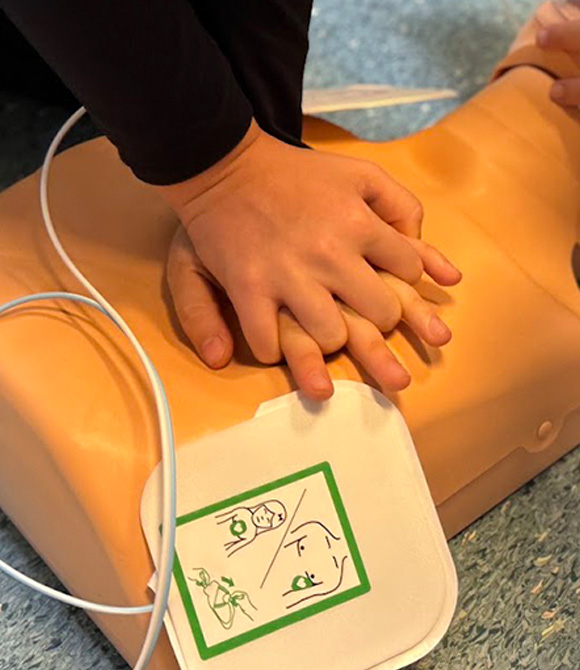
This official training cycle prepares you to transfer patients, provide basic health and psychological care in the pre-hospital environment, carry out health teleassistance and collaborate in the organization and development of emergency plans, foreseeable risk devices and health logistics in the face of an individual or collective emergency.
Train now as a technician in Health Emergencies.
Presential modality. 2000h distributed in two academic years.
- Official qualification
Health Emergency Technician
- Duration
2 academic courses (2,000h)
From September to June / Hours: from 8:30 am to 3:00 pm
- Access
ESO, Middle Grade Access Test
- Centers
Balmes, Vitae Online
Curriculum
First course
| Professional Module | Hours |
|---|---|
|
Preventive mechanical maintenance of the vehicle Analyze the operation of the ambulance’s various systems to detect malfunctions and control vehicle maintenance, ensuring its optimal operability. |
66 |
|
Initial health care provisioning in emergency situations Perform cleaning, disinfection, and sterilization procedures of the equipment and control the stock and materials of the sanitary vehicle. |
165 |
|
Initial health care in emergency situations Apply basic life support techniques and classify victims according to severity and likelihood of survival. |
198 |
|
Evacuation and transfer of patients Intervention spaces are set up to apply mobilization and patient immobilization procedures for transferring patients to the health center. |
284 |
|
Psychological support in emergency situations Apply psychological first aid to those affected by an emergency or catastrophe using different types of language and communication, such as those employed by the Boy Scouts. |
66 |
|
Emergency plans and arrangements for foreseeable risks Activate, design and execute emergency plans defining natural, human and technological risk maps. |
66 |
|
Telemergencies Receive and assess requests for medical assistance in emergency situations. |
66 |
|
Basic anatomo-physiology and pathology Know the organization of the human body, health and disease. |
99 |
|
Itinerary for employability I Learn to prevent occupational hazards and social skills |
99 |
|
Professional English Know the grammar and vocabulary of the professional field. |
66 |
|
Professional Catalan Know the grammar and vocabulary of the professional field. |
66 |

Second course
| Professional Module | Hours |
|---|---|
|
Special health care in emergency situations Perform procedures to care for patients with traumatic injuries, physical, chemical, and biological agents, organic, neurological, and psychiatric emergency pathologies, and intervene in situations of imminent childbirth. |
264 |
|
Health logistics in emergencies It proposes health organizational deployments in emergency situations, estimating the first intervention material necessary according to the type of emergency or catastrophe. |
99 |
|
Itinerary for employability II Improvement employability, individual development plan. |
66 |
|
Intermodular project Preparation and realization of professional events |
198 |
|
Digitalization applied to the production system Integration of digital technologies in the production and management processes of a company. It includes the use of tools such as automation, the Internet of Things (IoT), artificial intelligence, and data analytics to optimize efficiency, improve quality, and reduce costs. |
33 |
|
Optional professional module Deepen knowledge of the professional field. |
99 |
|
Sustainability applied to the productive sectors Implementation of practices and strategies aimed at balancing economic development with environmental protection and social welfare. |
33 |
Access
You can access by fulfilling any of these requirements:
- The title of graduate in compulsory secondary education.
- To have passed the specific course for access to intermediate cycles.
- The title of technician or auxiliary technician.
- Other equivalent studies for academic purposes.
- To have passed the university entrance exam for students over 25 years of age.
- To have passed the mandatory modules of an initial professional qualification program (PCPI).
- A diploma to access a higher level training cycle.
Those who do not meet any of the above-mentioned requirements must pass an entrance exam. To take the test you must be at least 17 years of age in the year in which the test is taken.
The Vitae Method
We train with values to make the Vitae experience a lifelong learning experience.
- Here you are the center: a method focused on the students and their needs.
- We learn by doing and enjoying: first the practice, then the theory.
- We analyze to improve the performance of the dynamics applied.
Learn with an innovative methodology that goes beyond conventional teaching.
Exits
professionals and academic continuity
With this training cycle you can work as:
- Medical transport technician.
- Health emergency technician.
- Operator of teleassistance or emergency and urgency coordination centers.
Do you want to continue your training?
The intermediate degree in Health Emergencies gives you access to the baccalaureate or a higher vocational training cycle.
Modalities
On-site
We believe in the importance of practice, the environment and the connection between teachers and students.
All Vitae schools are located in reference entities within each area and feature high-level facilities, providing a 100% immersive learning experience under the guidance of an active, close, and constantly evolving teaching team.
The Balmes Center, the heart of the Vitae University School, comprises 3,000 m² distributed over two floors, featuring classrooms, multipurpose rooms, and common areas. The ideal environment in which to start your professional career.
Online
Do you want to combine studies and work? We make it easy for you to develop your potential!
Study a distance learning vocational training program and learn at your own pace.
In the online Health Emergencies degree program, you can connect to live meet sessions, maintain a close relationship with the teaching staff and classmates, access forums, tutorials, and interactive exercises.
Evaluation is by means of written tests and face-to-face practicals.
Internship at the company
Facing real situations in the working world is a differential in your training. For this reason, we are building a network of collaborating companies in continuous growth, where you will have the opportunity to stay with the company and apply the knowledge you have gained in school. As of today, we have 900 companies and entities collaborating in the field of sport and health. Internships are essential for your training and for deciding your career path!
Related degrees
By completing some of the modules of the Medium Degree in Health Emergencies, you can accredit in the SOC a series of qualifications and gain access to the labor market before finishing the cycle.
Teaching staff
We accompany you on your way to a quality professional future.
Choosing Vitae means choosing to train with a young, dynamic, and multidisciplinary team that is connected to the sports, health, and sociocultural sectors in their daily work.
A teaching team that shares its know-how with you to prepare you to make the leap into the working world and continue to grow.
Success stories
We believe in the power of personal experiences to learn and also to communicate. That is why we dedicate a space to share inspiring stories of people who have passed through our classrooms and have taken everything they have learned at the school to their professional, sports, and life trajectories.
TRAIN YOURSELF
Are you ready to take the next step towards your future career?